Please check email link or scroll down to read the full article. Thanks for joining us today. There is a video attached at the bottom of this post.
Aloha es 73 de Russ (KH6JRM).
---------------
Building an off-center fed (OCF) Dipole
This type of antenna is a popular antenna design as the performance is very good across the HF bands and requires little or no tuning. It’s a dipole fed off center with a 4:1 balun at the offset feed point. The antenna shown covers 80, 40, 20 and 10 meters. The formula can also be used to adjust the overall length to cover more or fewer bands and the resulting overall length. 160-10m, 80-10m or 40-10 meters depending on your available space. Other bands will require a tuner.
Design Parameters
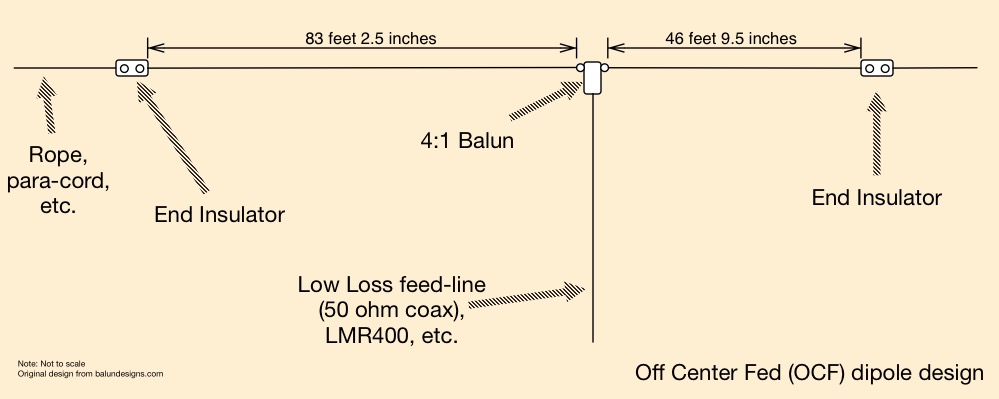
For an 80-10 meter OCF dipole antenna, divide the 1⁄2 wavelength standard of 468 by the lowest operating frequency of 3.6 MHz and you arrive at an overall length of 130′. This is the length of a standard dipole but instead of dividing the result in half, use a 36/64% offset to determine the feedpoint.
Off-Center Fed Dipole Design
The total length of 130′ multiplied by 0.64 (64%) gives the long leg length of 83.2 feet. The short leg length is the remainder or 46.8 feet. If you prefer, you can also correct the length based on the velocity factor of the wire (.975) although this generally does not make a noticeable difference in the antenna performance.
Using a quality 4:1 balun at the feed point is crucial to the overall performance of the antenna when they are fed with coaxial cables. The feedpoint impedance at the offset is at or about 200 Ohms and the balun will provide good transformation to the coax feedline impedance of 50 Ohms. Many hams (including me for too many years) connect the center conductor of the coaxial cable to one side of the dipole, and the shield to the other. It works, but this is not good practice.
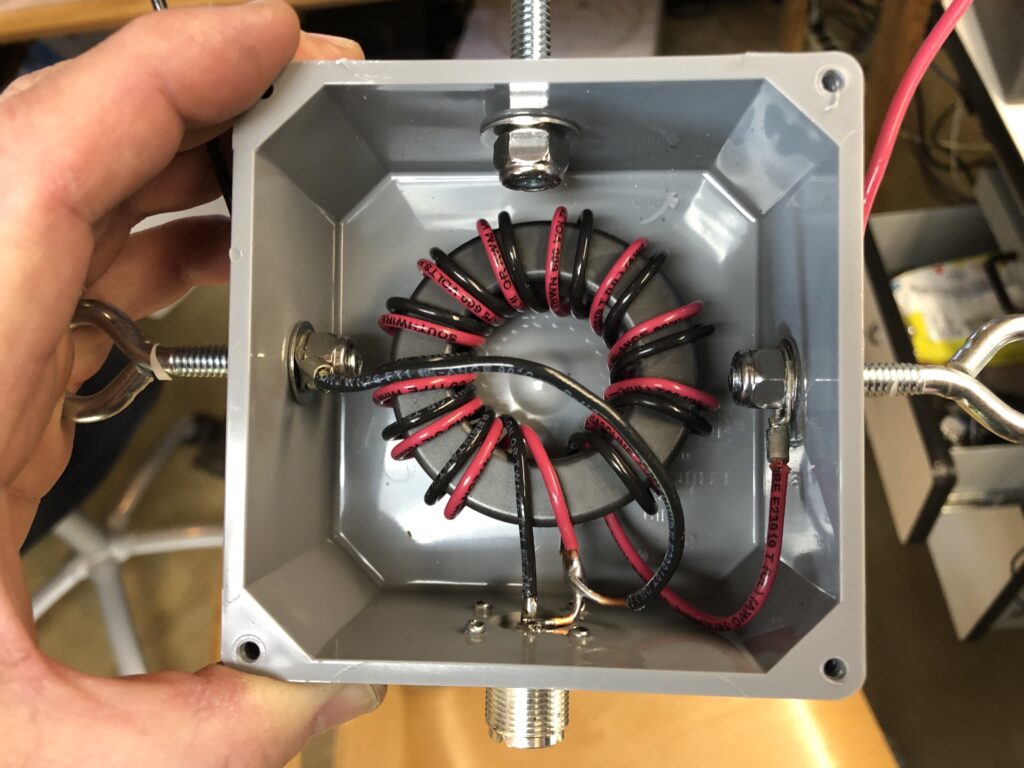
4:1 Balun built from spare parts around the shack.
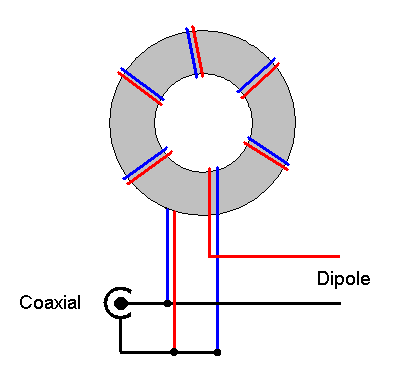
I had the components to build my own 4:1 balun so I built this the day before Christmas 2019. I bought the case from Home Depot and the eye-hooks from Ace Hardware locally. I used #14 solid wire which is 12 turns around the toroid (4 feet of #14 wire). I had the core that I bought at the Berryville Ham Fest over the summer. The photo should show how to construct the balun for yourself. There are a ton of youtube videos on how to do this. It’s easy, just takes some time. Here is a schematic of the design.
4:1 Balun Schematic
To build the OCF dipole (in this case 80-10m) cut a single length of wire to an overall size of 133′. The 3 additional feet of wire will be used to fine-tune the OCF after you install it. Next, cut the 133’ into two separate lengths of 85′ 2 ½“ and 47′ 9 ½”. Strip one end of each length, install through the balun strain relief and solder to the connecter at the balun. Now install the other end of each wire through the end insulators but leave 1 foot of wire dangling from the short length and 2 feet of wire dangling from the long length. The antenna can be installed in an inverted V configuration keeping in mind that this design changes the feedpoint impedance and will tune differently.
After installing the OCF, check the resonant frequency on or lowest SWR for 80 meters. It should be in the low portion of the 80 meter band (e.g., 3.5 MHz or lower). Now you can begin trimming small lengths of wire off each end of the OCF to obtain the lowest SWR at 3.6 MHz. Begin with no more than 6 inches in total with 4 inches removed from the long leg and 2 inches off the short leg. Be sure to trim each wire proportionately. For example, if you cut 6 inches off the long leg, cut only 3 inches off the short leg. Depending on your surroundings and antenna height, 80m may only reach an SWR of 1.8 – 2.0:1. This is normal and the higher bands will be lower.
This antenna has been calculated using 14 AWG stranded copper wire, with the jacket on. If you use bare twisted or solid copper wire, the lengths may change slightly.
I’ve used this antenna for many hours over the last couple of days with great results. Like everything else there are some things I would change when I go back and build it again. I soldered the ground lead which I would loop through the rivet instead. Minor stuff.
This information was pulled from many sources. I also watched this video on YouTube that I thought was helpful. Often, I learn from watching, not reading.
If you want to buy your own balun and/or complete antennae you can go here or here.
Hopefully this helps you build a similar antenna you can use at your own station.
Thanks to "Tinker John" (W5CYF) for this inexpensive, homebrewed cable window pass through project. All you need are a few basic tools, bulkhead connectors, and small lumber pieces. If you can't see the video, please insert this title URL into your browser search box: https://www.youtube.com/watch?v=KRmbezrkGoc. Thanks for joining us today. Aloha es 73 de Russ (KH6JRM). Here are some comment from "Tinker John" (W5CYF): A simple and effective method of passing coax antenna cable through a window sill. Easy and inexpensive to make. Used for any type of antenna cable including ham radio, TV, CB or SWL. Suggested items that may be related to this video: https://www.amazon.com/shop/w5cyftink... This video shows how to create a window pass-through for coax cables, using readily available materials. The creator demonstrates a simple and inexpensive method for bringing coax cables from the outside into a ham shack, using a piece of printed circuit board and a pin...
If you want to experiment with unconventional antenna designs, please consider adapting US military HF antennas. These antennas are easy to build and perform well on several amateur radio bands. In this video, Walt (K4OGO) builds a Terminated End Fed V Antenna (TEFV). The antenna is broad banded, requires no antenna "tuner", and covers frequencies from 1.8 to 30 MHz. If you can't see the video, please insert this title URL into your browser search box: https://www.youtube.com/watch?v=CCmi84GMNJQ. Thanks for joining us today. Aloha es 73 de Russ (KH6JRM). Here are a few comments from Walt (K4OGO): built a US Military TEFV antenna to spec and worked the HF bands #hamradio #portablehamradio #hamradioantenna Link to Palomar Engineers maker of the 12:1 balun and 600 ohm termination resistor: https://palomar-engineers.com Transcript Follow along using the transcript. Show transcript COASTAL WAVES & WIRES 36.3K subscribers Videos About Salty Walt's Patr...
Here's another great 6 meter band antenna idea from Hayden (VK7HH). This vertical antenna is based on the "classic Cobra Antenna" described by the late Bill Orr (W6SAI). The antenna is easy-to-make using a few basic tools, a PVC mast, some RG-58 coaxial cable, and a few connectors. This antenna is suitable for both home and portable use. If you can't see the video, please insert this title URL into your browser search box: https://www.youtube.com/watch?v=4h7UGNbWmsY. Thanks for joining us today. Aloha es 73 de Russ (KH6JRM). Here are some comments from Hayden (VK7HH): This is a really simple and easy to construct antenna that will get you on the air on the six meter band using only RG-58 coax! I needed a quick and simple antenna for my WSPR beacon over the summer season. Enter the coaxial dipole or aka flowerpot antenna! Buy RG-58 👉 https://geni.us/HCI8NG (Amazon) ► $15 OFF at Radioddity: http://radioddity.refr.cc/haydenvk7hh Above links are affiliate The des...


Comments
Post a Comment